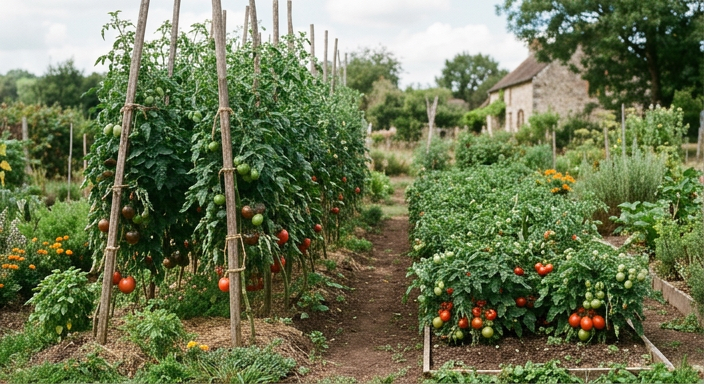
When we picture a tomato plant, we often imagine a tall stem tied to a stake, growing all summer long and eventually towering over the gardener. Yet not all tomatoes behave this way. There are two main growth types: indeterminate varieties and bush (or determinate) varieties. Understanding the difference helps you choose the right variety for your space — whether you have a large kitchen garden or just a balcony.
Originally, the tomato was a large climbing plant
The wild ancestors of our modern tomatoes naturally produced long stems that kept growing as long as conditions were favourable. This characteristic still exists in many old and modern varieties known as "indeterminate". These tomatoes keep producing new leaves, new flowers, and new fruit right up until the first frosts. They can easily exceed two metres in height when well grown.
Indeterminate tomatoes
Indeterminate varieties grow without any real limit. Their growing tip never ends in a flower truss — the plant keeps extending its main stem throughout the season. This is the case for many well-known varieties:
- Coeur de Bœuf (Oxheart)
- Rose de Berne
- Black Krim
- Green Zebra
- Pineapple
These tomatoes often give a harvest spread over several months. In return, they require sturdy stakes, regular tying in, and more space. In a small garden, they can quickly become unruly.

The rise of bush tomatoes
Over generations of selection, gardeners discovered and kept tomatoes that carried a particular natural mutation. Instead of growing indefinitely, these plants stop when the tip of the stem turns into a flower cluster. The plant becomes more compact and takes on a bushy form. These are known as determinate tomatoes.
Why choose a bush tomato?
The main advantage is space. These varieties generally stay lower and more compact. They are perfectly suited to balconies, terraces, raised beds and large pots. Some can even be grown without staking when the fruits remain modest in size — a simple crate, a small support, or sometimes no support at all is enough. For gardeners with limited space, this is often the simplest solution.
Good to know
To recognise a bush tomato on a seed packet, look for the word "determinate" or the letter D in brackets. Indeterminate varieties carry the word "indeterminate" or the letter I.
The limits of compact forms
Bush tomatoes often produce their fruit over a shorter period. The harvest tends to be more concentrated: you get a large crop over a few weeks, then production drops sharply. Indeterminate varieties, by contrast, often keep producing fruit well into autumn. The choice depends on what you're after: a spread-out abundant harvest, or a compact plant that's easy to manage.
Varieties suited to small spaces
Many bush tomatoes have been specifically bred for container growing. Notable examples include:
- Tiny Tim
- Red Robin
- Vilma
- Tumbling Tom
- Balconi Red
Some reach no more than 30 to 50 cm in height, yet still produce a fine crop of cherry tomatoes.
Key takeaways
A tomato plant doesn't have to be a two-metre vine tied to a stake. Bush varieties have made tomato growing accessible almost anywhere: balcony, terrace, courtyard or small kitchen garden. Before buying your seeds, simply check whether the variety is determinate or indeterminate. That one small detail completely changes how the plant will fill your space — and how much time you'll spend chasing down stakes.