We walk past them without really looking. Some grow at the foot of hedges, others in lawns, at the edge of the vegetable patch or in woodland. And yet, long before uniform, calibrated vegetables filled the shop shelves, wild plants had their place in what people ate.
What's surprising is that they aren't merely edible. Some of them have a genuinely interesting nutritional profile.
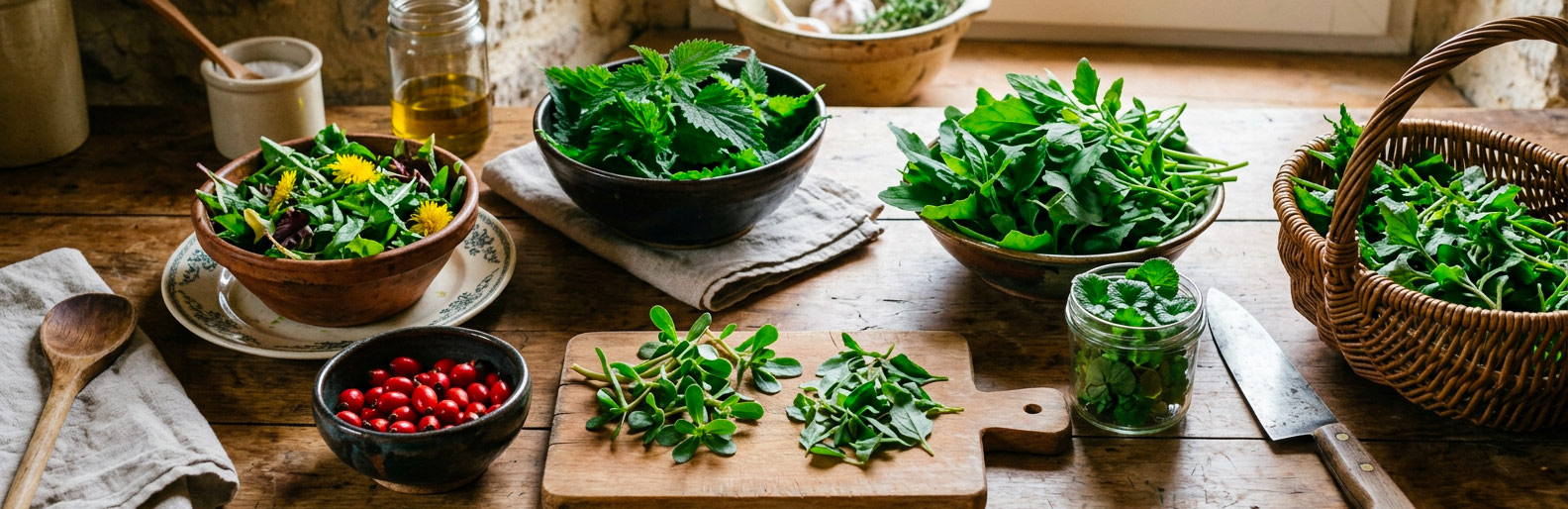
Leafing through a table of edible wild plants, taken from François Couplan's Guide nutritionnel des plantes sauvages comestibles, I felt like looking a little closer. Nettle, dandelion, purslane, lamb's quarters... very ordinary plants sometimes post figures that are anything but.
One thing to bear in mind, though: the nutrient content of a wild plant can vary with the soil, the season, the stage of growth and the conditions at harvest. This is particularly well documented for nettle.
Before picking anything at all
Two non-negotiable rules
You have to identify the plant with certainty. Well, yes: this one didn't come from a seed you cheerfully bought from a seed merchant. And steer clear of roadsides, polluted ground generally, and the margins of fields treated with pesticides.
Nettle: far more than a plant that stings
It's probably the best known of them all. And once you look at what it contains, you understand rather better why nettle was used as a food plant for so long.
Analyses carried out on fresh leaves have measured roughly 3.7 to 6.3 g of protein and 278 to 788 mg of calcium per 100 g, depending notably on the season of harvest. The variation is wide, which makes single figures a little misleading, but the conclusion holds: nettle is a thoroughly worthwhile leaf vegetable.
How to eat it
Nettle soup is probably the best place to start.
A recipe published by Good Food pairs the leaves with potato, onion, carrot and leek. The nettles go in only at the end of cooking, then the whole thing is blended. Once cooked, they lose their sting entirely.
You can also use them rather like spinach: as a filling, in a stuffing, in an omelette.
Dandelion: our grandparents' wild salad
There's nothing exotic about this one. It grows just about everywhere, and previous generations didn't wait for foraging to come back into fashion before putting it on the plate. We all have a memory of a grandfather with a knife in hand, ready to lift the young dandelions out of the garden.
In Couplan's table, dandelion leaves are listed as a good source of calcium and vitamin C.
How to eat it
With bacon.
Dandelion salad with lardons genuinely belongs to French traditional cooking. You find it in Lorraine, in the Dauphiné, in the Ardennes and in Lyonnaise cuisine. The young leaves are dressed, then the still-hot lardons are poured over the top, sometimes with eggs and croutons alongside.
So it isn't a modern recipe invented to use up a wild plant. It was simply... salad.
Rosehips: the fruit we forget to pick
This may be the most surprising of the lot.
After flowering, many roses produce small red or orange fruits: rosehips. Dog rose produces them in abundance, but garden roses of the genus Rosa can form them too.
These are the famous fruits that hold the itching powder. In French their nickname is rather less polite than "rosehip".
They're best known for their very high vitamin C content, though the figures vary enormously with the species, the ripeness of the fruit and the growing conditions.
How to use them
As rosehip syrup.
Here's a very traditional method: the fruits are chopped and cooked in water, then carefully strained. The resulting juice is cooked again with sugar to make the syrup.
Straining is not a formality
It has to be done through fine cloth, muslin or a clean tea towel. A sieve, however fine, won't hold back the tiny hairs around the seeds. Those hairs genuinely irritate the digestive tract. This isn't a question of comfort.
Rosehip jams, jellies and purées are old classics too. In the end, this small fruit we so often leave to dry on the bush may have more of a place in the kitchen than we think.
Purslane: a salad that grows itself
Purslane turns up readily in summer, in gardens and cultivated ground.
Its small fleshy leaves and tender stems have a slightly tangy, salty flavour. They can be eaten raw or cooked. Purslane is well known for its high omega-3 fatty acid content.
In Couplan's table, 100 g of leaves provide 68 mg of magnesium for only 23 kcal.
How to eat it
It's hard to be simpler: as a salad.
A recipe published by La Cuisine d'Annie uses a bunch of purslane, simply washed and cut, with lemon juice, a drizzle of olive oil and a few walnuts or pine nuts. Both the leaves and the tender parts of the stems are used.
In other words, you can genuinely treat it like an ordinary salad leaf.
Lamb's quarters: the wild spinach
Lamb's quarters is probably less familiar by name, even though it's extremely common. Its young leaves were eaten as a vegetable for a very long time, and it's used much the way spinach is.
Its nutritional profile is worth a look. In Couplan's table, 100 g of fresh leaves show 370 mg of calcium, 236 mg of vitamin C and 4.3 g of protein. Not bad for a plant that comes up on its own between two rows of vegetables.
How to eat it
Like spinach.
I came across a simple recipe that makes you want to try it: lamb's quarters in cream. The leaves are cooked briefly with shallot and garlic, then a little stock and cream go in. You also find quiches, savoury cakes and pancakes filled with it.
It may be one of the easiest wild plants to slot into everyday cooking: if a recipe works with spinach or beet tops, it will work with lamb's quarters.
Ground ivy: treat it as a herb
Its name causes confusion easily.
Ground ivy (Glechoma hederacea) is not the climbing ivy (Hedera helix) you see running up walls and trees. It's also regularly confused with spotted dead-nettle, which looks a little like it and grows in the same places.
Ground ivy is a small creeping plant with rounded leaves and violet flowers. It's a relative of mint, and its flavour is far more pronounced than the plants above, so it's better thought of as a herb than a vegetable.
And that's precisely why there are no nutritional figures for its leaves. Nobody has ever measured its calories or protein per 100 g, because nobody eats 100 g of it. Its composition is well known, though: tannins, an essential oil, vitamin C, potassium, choline and bitter principles.
Why you shouldn't overdo it
That essential oil contains pulegone, the same compound found in pennyroyal. At high doses it's toxic to the liver.
There's no risk in a few leaves in a dish. But this isn't a plant you use by the handful, and it's best avoided during pregnancy.
How to use it
As a pesto. Blend the leaves with olive oil, walnuts or hazelnuts and a little soft cheese. You can also go the more classic route with garlic, pine nuts and pecorino. One to try: with cake, or with chocolate.
A few leaves are enough here. The flavour is powerful, and for the reasons above, moderation isn't only a matter of taste.
A precaution that applies to two of them
Lamb's quarters and purslane both contain oxalates in notable amounts, as spinach and sorrel do.
For most people this poses no problem at all in normal amounts. But anyone prone to kidney stones, or being treated for a kidney condition, would do well to talk to their doctor before making a habit of them.
Boiling them and discarding the water reduces some of those oxalates.
Wild plants, but real food
What I like most about these plants isn't really discovering that they can be eaten. It's that they have genuine nutritional value. And that people once knew perfectly well what to do with them.
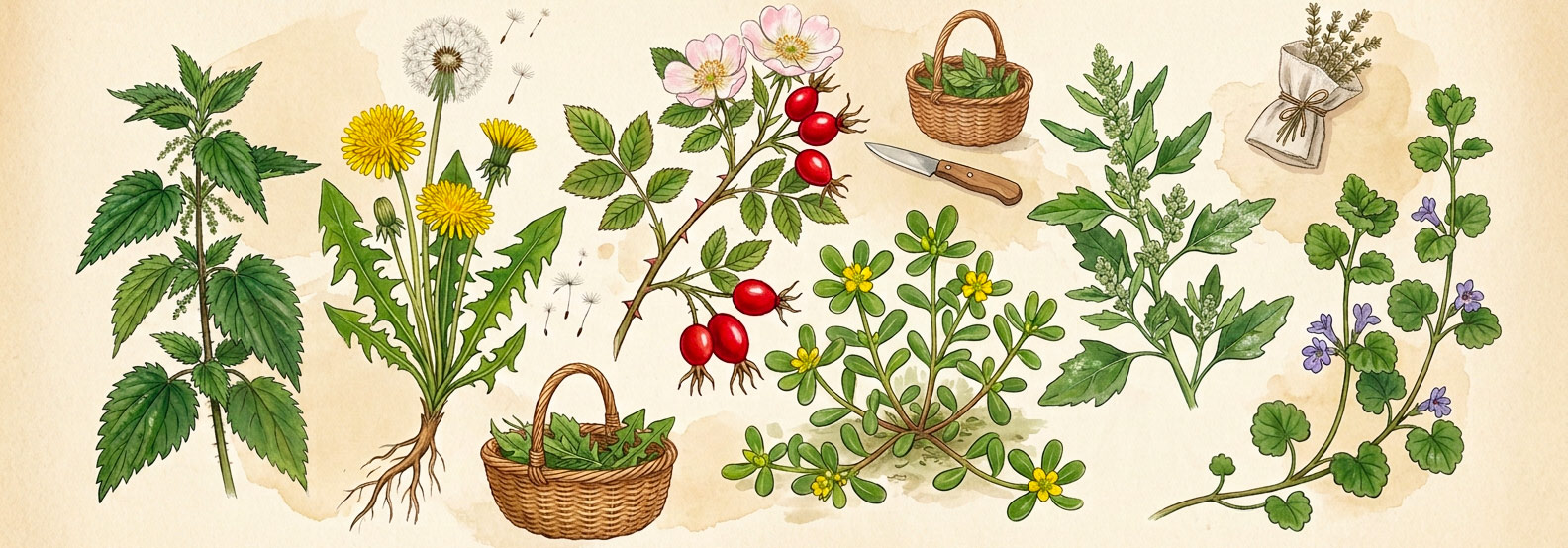
- Nettle went into the soup.
- Dandelion became a salad.
- Purslane was eaten raw.
- Lamb's quarters stood in for spinach.
- Rosehips turned into syrup or jam.
- And ground ivy flavoured dishes like any other herb.
No extravagant cooking is required. It's mostly a matter of starting to look again at what grows around us.
"And perhaps the next interesting wild plant isn't deep in a forest. It's already growing in the garden."