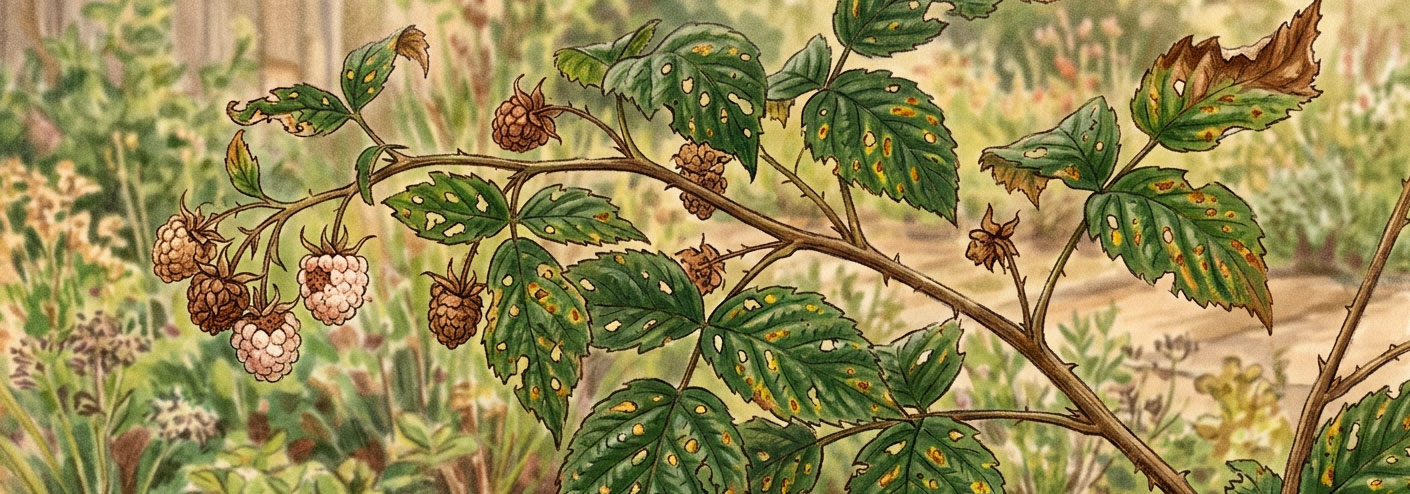
This year my raspberry plant took everything. Several heatwaves, a hailstorm, holed leaves, tiny stunted raspberries, some of them completely white.
There is a sap-sucking shield bug hanging around, a squash bug relative. But it can't be the only culprit. And honestly, it probably isn't even the main one: this bug feeds mostly on sorrels, docks and knotweeds. On a raspberry plant it's usually a passing visitor rather than a genuine pest.
White, hard raspberries
The first suspect is heat and direct sun. After repeated spells of high temperatures, exposed fruit can go pale or dry out.
In that case, there's no point reaching for an insecticide. What helps is:
- keeping the moisture steady at the base;
- watering deeply rather than superficially;
- mulching to keep the soil cooler;
- planning for some shade, if the problem returns every summer.
Light netting or partial shade can sometimes make a real difference.
A sap-sucking shield bug
These bugs have a rostrum that lets them pierce plant tissue and draw out the contents. They can damage some of the fruit.
But if you spot one or two, there's no need to reach straight for a treatment. I'd rather start with something far simpler: picking them off by hand. Check the fruit and leaves regularly, remove the bugs you find, and take off the fruit that's genuinely ruined.
As long as the attack stays limited, that can be quite enough. You often read that these bugs avoid garlic. It's a piece of gardening lore that circulates widely, but I've never seen it seriously demonstrated. Worth a try if you fancy it, without expecting miracles.
Holed leaves
Here it's worth resisting quick conclusions. A hole in a leaf doesn't automatically mean an insect ate it.
At my place it also hailed. Hail can puncture, tear or bruise leaves, sometimes quite spectacularly.
After hail, don't overcorrect
There's nothing to be done. Leave the still-functional leaves in place and remove only those that are badly damaged, fully shrivelled or breaking down. The plant needs whatever leaves it has left in order to recover.
And if the holes really are insects?
Some holes have distinctly nibbled edges. Then it's worth looking closely at:
- the undersides of leaves;
- young shoots;
- leaf stalks;
- hidden spots within the foliage.
Look for caterpillars, larvae or small beetles. First step, always the same: pick them off by hand, ideally early in the morning while they're still sluggish.
After that, it depends what you find.
Caterpillars. Bacillus thuringiensis is the natural option that genuinely works. It's a bacterium approved for organic growing, it targets caterpillars only, and it leaves bees and beneficial insects alone. Spray in the evening, on dry foliage.
Aphids or soft-bodied insects. Diluted insecticidal soap, sprayed in the evening, is enough in most cases. It works on contact, so you have to aim at the undersides of the leaves.
Adult beetles. Here I have to be honest: no natural preparation is really effective. Hand-picking remains the best option, possibly backed up with insect netting if the problem returns every year.
As for fern or tansy liquid feeds, often recommended, their actual effectiveness is much debated. I wouldn't make them my first line of defence.
What about diatomaceous earth?
You see it everywhere, and it does genuinely work: its abrasive particles scratch insect shells and the insects dehydrate.
But it makes no distinction at all. It kills ladybirds, hoverflies and pollinators just as reliably as pests. On a raspberry plant in flower or in fruit, I leave it alone.
As a barrier at ground level against crawling insects, perhaps. Never on the foliage. And it stops working with the first rain, and you need a mask to apply it.
In any case, before spraying anything at all on a plant already in poor shape: a limited attack on an exhausted raspberry plant doesn't necessarily justify a treatment. Sometimes doing nothing is the right call.
Spotted leaves that then go holey
Some leaf diseases can also cause spots that eventually dry out and drop away, leaving a holed appearance behind.
If the leaves show brown, grey or pale spots before perforating, it's better to:
- remove the badly affected leaves;
- avoid wetting the foliage unnecessarily;
- improve airflow between the canes;
- not let diseased debris pile up at the base.
Once again, not all holes come from the same place.
After the heatwaves: getting water back into the system
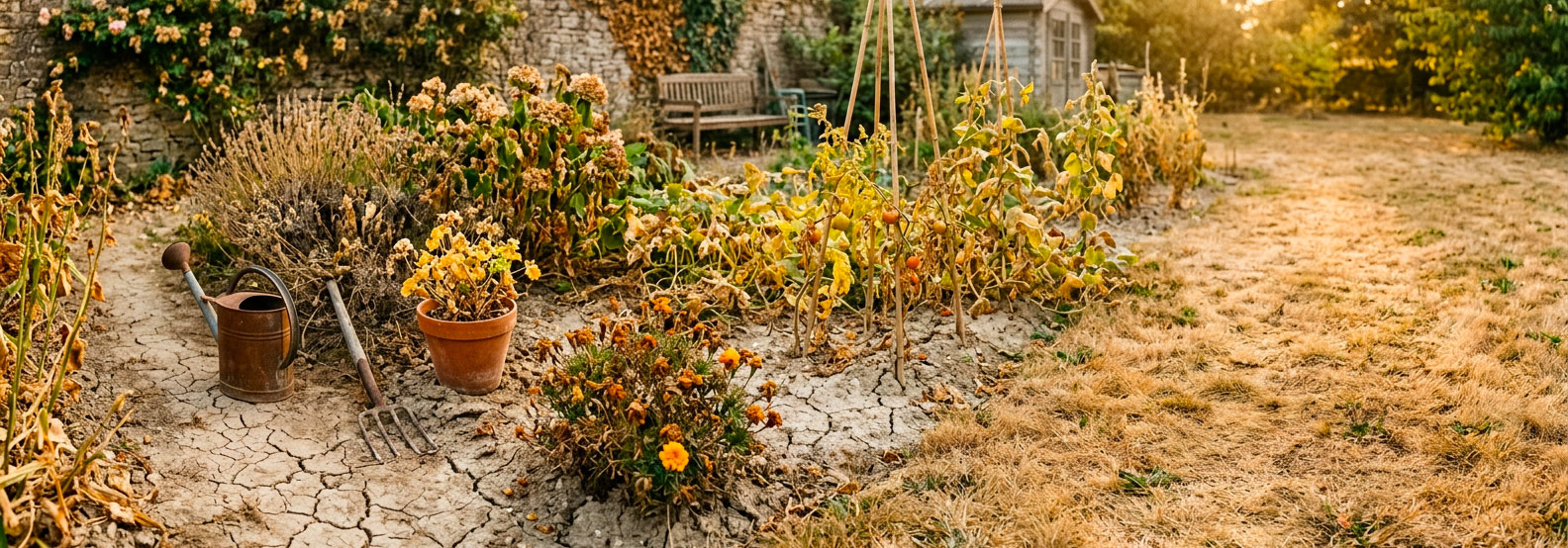
After weeks of heat, the main problem may simply be an exhausted plant. Raspberries like cool soil and cope badly with long dry spells.
At this time of year I favour watering less often but more generously, so the water actually reaches down to the roots.
"The aim isn't to keep the surface permanently damp. The aim is to stop the whole root zone drying out completely between waterings."
Mulch now
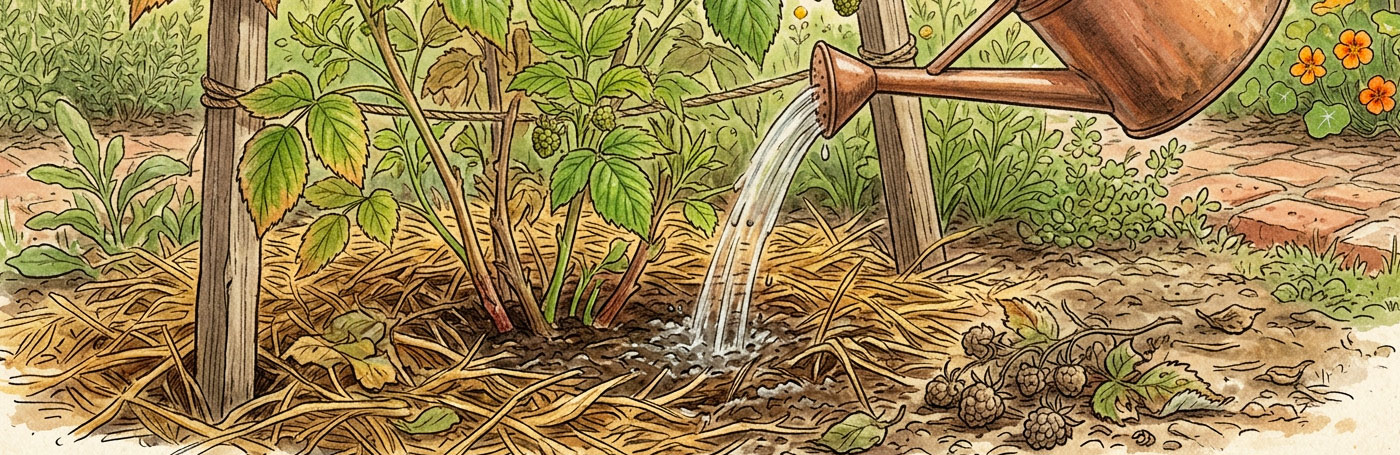
Mulching is probably one of the most worthwhile things you can do. A layer of organic matter at the base helps to:
- limit evaporation;
- keep the soil cooler;
- smooth out sharp swings in moisture;
- gradually protect the soil structure.
Coarse compost, fallen leaves, straw, wood chip... Just avoid piling the mulch directly against the canes.
Should you feed it?
Not necessarily. A plant already stressed by heat, hail and pests doesn't need to be told to produce a burst of new growth straight away.
I'd rather give a modest topdressing of well-rotted compost than a heavy dose of nitrogen fertiliser. The goal is to help the soil and the roots recover, not to force the plant.
Should you prune?
Again: gently. You can take out:
- canes that are clearly dead;
- broken parts;
- badly diseased material;
- shrivelled fruit still hanging on.
But I wouldn't prune hard simply because the plant looks tired. After a difficult summer, what it mostly needs is to recover.
And for next year?
If the problem repeats every summer, it may be the conditions that need correcting rather than the plant. I'd look mainly at:
- The aspect. If the fruit scorches every year in the full afternoon sun, some shade can help.
- The soil. If it dries out very fast, more organic matter and a thicker mulch can improve things.
- The watering. Better to avoid long swings between total drought and a heavy soaking.
- The airflow. A raspberry plant that's too dense can encourage certain leaf problems.
Not all the damage comes from the same place
And that's exactly why I'm not going to look for a single treatment that fixes everything.
I'll do what seems most sensible instead: pick off the insects, remove what's genuinely finished, water properly, mulch, and let the plant recover.
Because after a summer like this one, what it probably needs most isn't another treatment. It's a bit of peace.