Every year, it's the same story. You open a seed catalogue, you come across a black tomato, a yellow one, an enormous ribbed one, an heirloom variety with a beautiful name... and three minutes later you want to grow twenty-seven of them.
The trouble is that a tomato that's excellent in a salad isn't necessarily the best one for making 15 litres of passata. And the other way round too.
So before choosing your varieties, it's better to start with a very simple question: what do I actually want to do with my tomatoes?
What do I want to do with my tomatoes?
For eating raw
For salads, on bread, or simply eating a tomato with a bit of salt, what you're after is mainly:
- flavour;
- a pleasant texture;
- juice;
- a skin that isn't too thick.
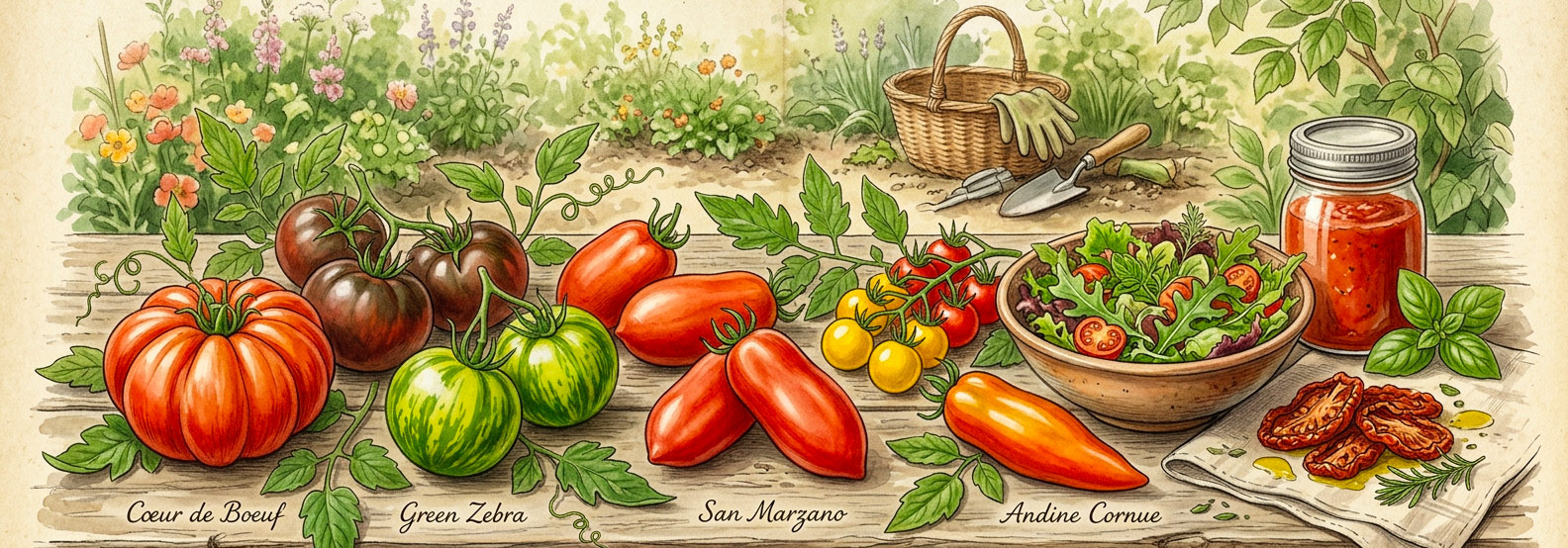
Big fleshy tomatoes, dark varieties or some of the multicoloured ones are often interesting for this. That's where varieties like Black Krim, Green Zebra, Beefsteak or Sweet 100 really come into their own.
They aren't necessarily the ones I'd choose to fill a pot with sauce. But at the table, that's another matter.
For sauces and passata
Here the criteria change completely. A very juicy tomato can be delicious raw, but it will need far more cooking to give you a thick sauce.
So for sauces, I prefer tomatoes that are:
- fleshy;
- low in juice;
- light on seeds;
- quick to reduce down to something thick.
The great classics are Roma, San Marzano, Andine Cornue and Sanzana. Less water to evaporate, less time on the hob. When you're processing several kilos of tomatoes, that adds up.
For preserving
For preserves, you're largely looking for the same qualities as for sauces. Dense flesh makes processing easier and gives you a less watery result. Elongated tomatoes of the Roma or San Marzano type are therefore particularly useful.
One variety, several uses
That doesn't mean a whole variety has to be reserved for a single use. A good tomato can perfectly well end up in a salad one day and in passata the next. The table I've put together simply shows which uses each variety is best suited to.
For stuffed tomatoes
Here you want something different again: a reasonably large, fleshy fruit that can be hollowed out without immediately collapsing. Big tomatoes like Beefsteak, Super Marmande, Tarasque or Saint-Pierre work well.
And incidentally, if they're all the same size, it makes life much easier in the dish. That detail may not be very botanical. But it matters enormously the moment you close the oven door.
For drying
For drying, water is once again the enemy. The denser and less watery a tomato is, the faster and more worthwhile the drying will be. Elongated varieties like San Marzano, Roma or Andine Cornue are among the best suited.
A big, very juicy tomato will dry eventually too, of course. It will simply take a lot longer.
What if I mainly want a big harvest?
Not everyone is chasing the exceptional tomato you eat reverently and in silence. Sometimes you just want crates of them.
In that case, pay more attention to:
- productivity;
- earliness;
- how long the harvest lasts;
- how well it suits your climate.
Varieties like Saint-Pierre, Tarasque, Moneymaker or Fandango may then be more useful than one chosen purely for its novelty.
And for small gardens?
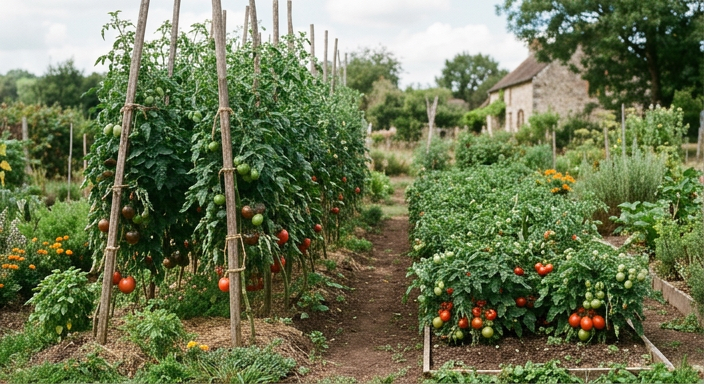
When space is tight, there's no point planting a giant variety that will end up colonising the terrace, the chair and possibly the neighbour. Compact or dwarf varieties like Primabel can be far better suited to pots and small spaces.
Some elongated varieties with a more compact habit, such as Sanzana, can also be worth a look if the aim is to produce for the kitchen without giving over half the garden to tomatoes.
Should you go for F1 hybrids?
F1 hybrids are neither miraculous nor diabolical. They're bred for particular characteristics: consistency, yield, resistance to certain diseases, or uniform fruit. For someone whose priority is securing a harvest, they can be a sensible choice.
On the other hand, if you want to save your own seed and keep a variety going year after year, they aren't the best option: seed collected from an F1 hybrid won't reproduce the original variety faithfully. It's simply a matter of knowing what you're after.
A very simple rule
Before buying your seed, do the opposite of what people usually do. Don't start by looking at the varieties. Start by writing down: I want tomatoes for...
- salads?
- sauces?
- preserves?
- stuffed tomatoes?
- drying?
- an early harvest?
- growing in pots?
And only then choose the varieties.
"It's far less romantic than buying every tomato with a pretty photo on the packet. But usually far more effective."
The printable table
So you don't have to work through all this again in front of every seed packet, I've put together a two-page printable guide.
FREE GUIDE
Which Tomato for Which Use?
Two pages to print and tuck into your seed box. Inside you'll find:
- →the most useful varieties for each purpose;
- →a comparison table for eating raw, stuffing, sauces, preserves and drying;
- →a selection by goal: harvesting early, producing a lot, growing in a small space or processing the crop.