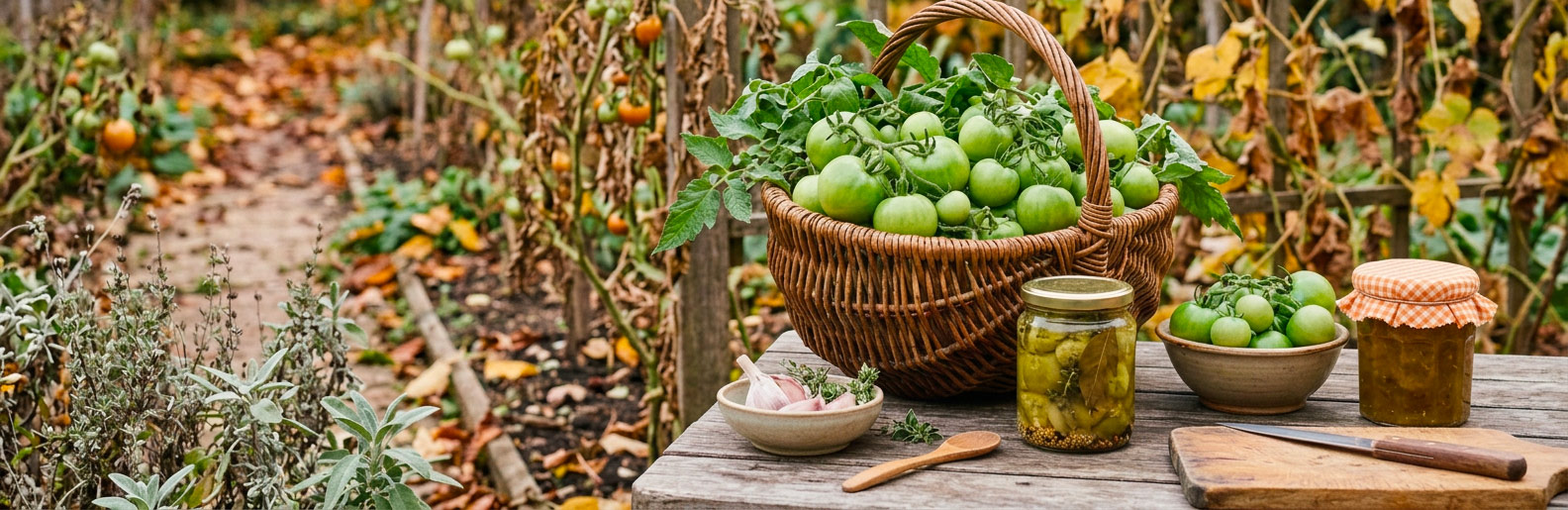
Every year it's the same picture. The nights turn cool, the sun drops, and there's still a pile of tomatoes on the plants that will never ripen.
You can try one of the many tricks for ripening them indoors. You can also turn them into a condiment, gherkin-style.
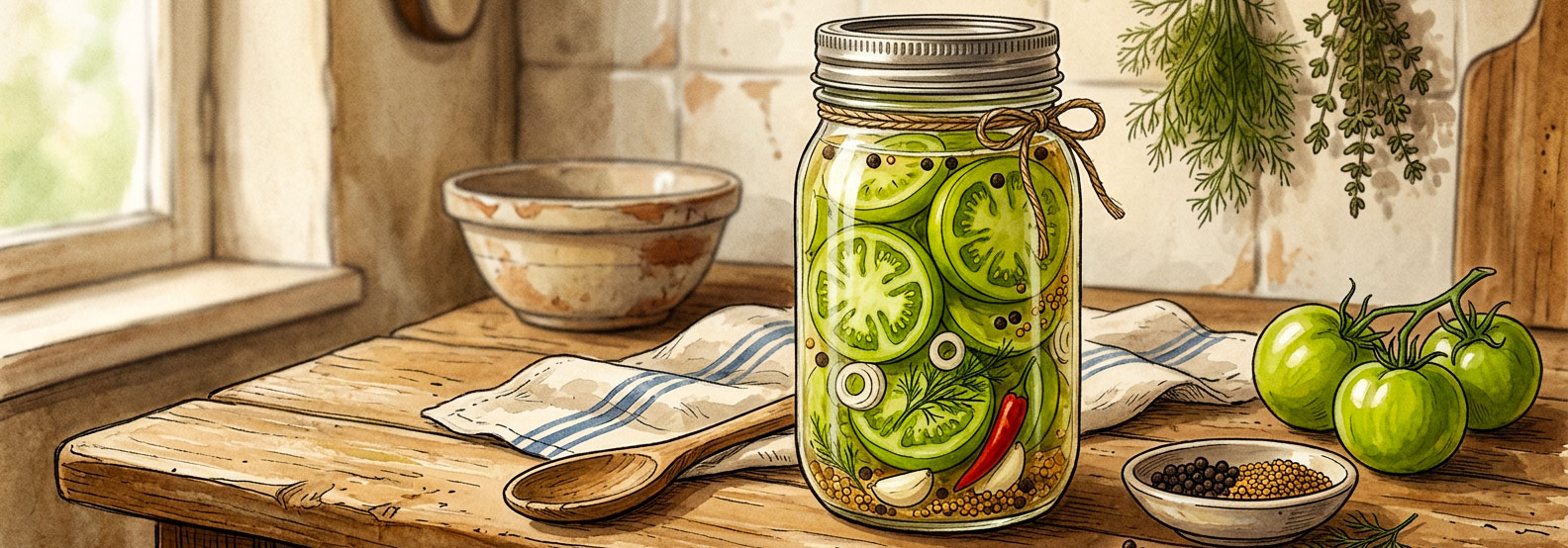
Green tomatoes in vinegar belong to that category of recipes people made without a second thought, and kept all year round. With onions, a clove, some peppercorns and tarragon, they become a sharp, sweet-sour condiment, very different from a ripe tomato.
Before you start
Green tomatoes are never eaten raw in any quantity. I didn't know that, though the idea had honestly never crossed my mind.
They contain tomatine, a compound that largely disappears with cooking or in a vinegar preparation. Pickled as they are here, no problem at all. In a raw salad, best avoided.
The point not to skip
Use a vinegar with at least 5% acidity. Shop-bought white wine vinegar and cider vinegar are fine, but artisanal vinegars aren't always. It's that acidity that does the preserving, not the salt and not the cooking.
Ingredients
For roughly 1 kg of green tomatoes.
- 1 kg green tomatoes
- 300 g small onions
- 500 ml vinegar (5% acidity minimum)
- 50 g salt for the salting stage
- 5 cloves
- 8 to 10 white peppercorns
- 1 bay leaf
- 2 to 3 small sprigs of tarragon
Salting, the day before
Choose tomatoes that are still properly green, firm and sound. Remove the stalks, wipe them and slice into rounds.
Peel the onions and slice them into rounds as well. If you can, pick ones close in size to the tomatoes: it looks better in the jar, and more importantly they cook the same way.
In a large glass, earthenware or stoneware dish, layer the tomatoes and onions, sprinkling salt evenly as you go.
Leave to macerate for about 12 hours somewhere cool, then drain.
No metal dishes
Salt and vinegar attack aluminium and iron, which will give the whole thing a metallic taste. Glass, earthenware or stoneware only.
The spiced vinegar
Pour the vinegar into a pan and add the cloves, white peppercorns and bay leaf.
Bring to the boil and let it boil for 2 minutes.
Then add the tomatoes and onions.
The cooking, very short
Let it simmer or steep for 3 minutes, then take the pan off the heat.
It's short, and deliberately so. The aim isn't to cook the tomatoes but to soften them while keeping some bite. Cook them longer and you'll end up with a compote.
Cover immediately and let everything cool completely in the vinegar liquid.
Into the jars
Once the preparation is cold, remove the whole spices used for cooking.
Pack the tomatoes and onions into clean jars.
Add the tarragon, then cover completely with the cooking vinegar.
Seal the jars.
Storing
Keep them somewhere cool, dry and out of the light.
"A piece sticking out above the vinegar is a piece that will go mouldy."
So the tomatoes and onions must stay fully submerged at all times. If the level drops, top it up with vinegar.
Wait about 2 to 3 weeks before eating them, so the spices can do their work. After that, you can enjoy your green tomato pickles over the course of the year.
How to serve them
Serve them as a condiment with cold meats, charcuterie, or in a potato salad.
What the recipe teaches you along the way
The method isn't just for green tomatoes.
Salt to draw out water, boil a spiced vinegar, blanch very briefly, cool in the liquid: that's the basic principle behind every vinegar pickle. Cucumbers, gherkins, cauliflower and pearl onions all work on the same pattern.
And this is where the vinegar does all the work. At that level of acidity, the bacterium responsible for botulism can't develop, which makes vinegar preserves considerably safer than water-bath canning. Provided, once again, that you stick to the 5% and keep everything submerged. At worst it goes mouldy on the surface, you can see the problem, and you throw it out. You don't poison yourself.