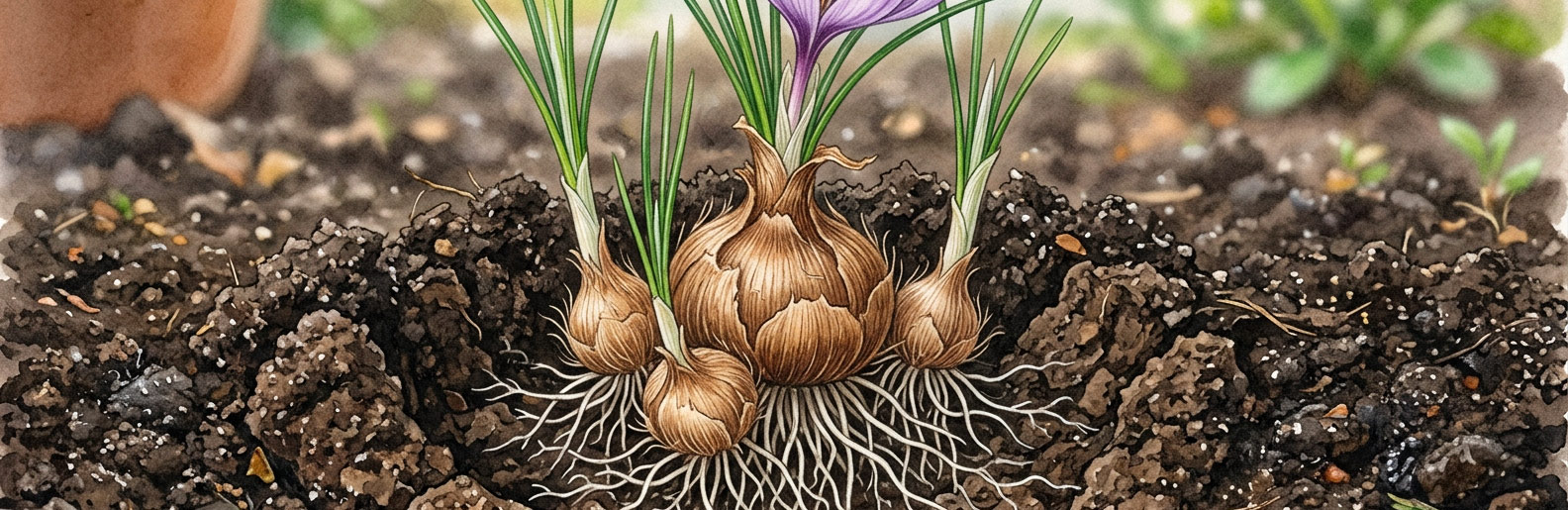
Last year, I planted a single saffron corm in my garden. This summer, when I dug it up, I didn't find just one, but four. So I'm still nowhere near a full saffron field, but my planting still quadrupled in a year, and despite what the price of this spice might suggest, saffron isn't particularly hard to grow.
That's one of the pleasures of growing saffron at home: the harvest starts out very modest, then the corms gradually multiply underground. With a little patience, a single corm can turn into a small clump, and eventually a real stash of homegrown saffron.
Saffron is an autumn crocus
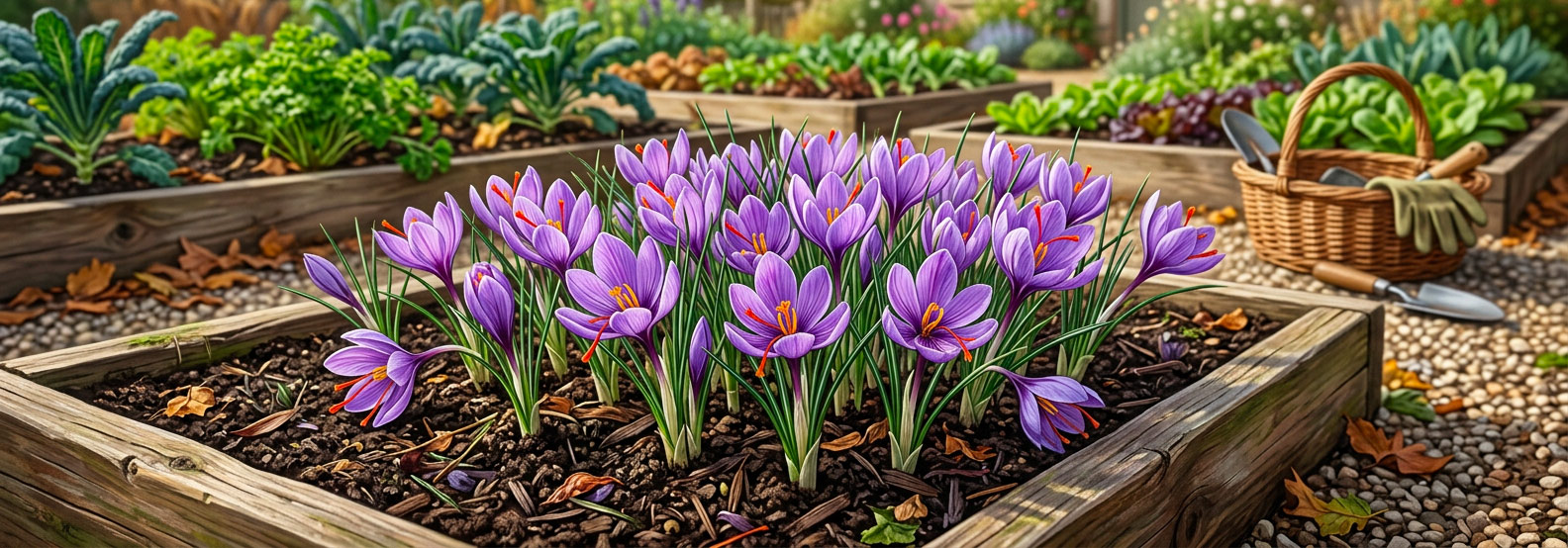
Saffron comes from Crocus sativus, a small purple crocus that flowers in autumn. At the center of each flower are three long red stigmas: these are the threads that get harvested, dried, and used in cooking.
What we usually call a bulb is, more precisely, a corm: a swollen underground stem where the plant stores its reserves. Crocus sativus doesn't produce fertile seeds. It multiplies solely through the formation of new corms underground: the original corm gradually depletes itself and is replaced by several daughter corms. So it's entirely normal to plant a single corm and find several the following year, though the smaller ones will need to grow bigger before they can flower.
When to plant saffron corms
Saffron corms are planted during their dormant period, from July to August. Planting is still possible into early September, especially in regions with mild autumns, but it's best not to wait too long: the corms need time to settle in before flowering, which usually happens in October or November.
Saffron's cycle is quite different from that of most other garden plants:
- corms are dormant during summer
- flowers appear in autumn
- leaves develop after or during flowering
- foliage stays present through winter
- leaves turn yellow and dry out in spring
- the plant goes dormant again as summer approaches
So don't pull out or cut the leaves while they're still green: they let the new corms rebuild their reserves and grow bigger for the following year.
Where to grow saffron
Saffron mainly needs two things: sun, and soil that doesn't hold onto water. Choose a well-exposed spot, ideally in full sun, with soil that's light, loose and above all very well drained.
Saffron copes with cold reasonably well. Its main enemy is really excess moisture, especially when water sits around the corms: in constantly waterlogged soil, they risk rotting.
If your soil is heavy or clay-based, a few options can help:
- plant the corms in a slightly raised bed
- lighten the soil with fine gravel or a draining material
- choose a well-exposed rockery
- grow them in a pot with drainage holes
Growing in a pot works very well for a small amount of saffron, as long as the container is deep enough and water can drain away easily.
How to plant the corms
Plant the corms with the pointed end facing up, at about 10 to 15 cm deep, leaving roughly 10 cm between each corm.
- Loosen the soil thoroughly.
- Remove the most bothersome stones and roots.
- Dig a hole about 10 to 15 cm deep.
- Place the corm, pointed end up.
- Cover with soil.
- Firm down gently.
- Water once, right after planting.
After that, there's no need to water continuously. The soil should stay cool while the corm settles in, but never waterlogged. In a pot, plant several corms without letting them touch each other, in light potting soil, with a good draining layer at the bottom of the container.
Can one corm really turn into four?
Yes. During its growing period, the planted corm uses its reserves to produce flowers and leaves, then forms new, small corms around or above itself. So the original corm doesn't exactly split into four pieces: it's gradually replaced by several daughter corms.
Finding four after planting just one the previous year is entirely plausible. The rate of multiplication varies depending on the size of the starting corm, soil richness, exposure, climate and growing conditions. Not all the new corms will necessarily flower in their first year: the larger ones can flower quickly, while the smaller ones may need two or three seasons to grow big enough.
Do you have to dig up the corms every summer?
No, it's not required. In well-drained soil, corms can stay in the same spot for several years: they'll gradually produce new corms and form an increasingly dense clump.
It can still be worth digging them up when:
- the clump has become too crowded
- flowering is declining
- you want to spread the corms to several spots
- you want to grow them in a new bed
- the ground becomes very wet in summer
Wait until the leaves are completely yellow and dry: the corms are then dormant. Lift them gently with a small fork, remove excess soil, and separate the daughter corms by hand. You can then replant them over the summer. There's no need to dig them up just to check whether they've multiplied: the less you disturb them, the better they settle in.
When does flowering happen?
Saffron usually flowers in October or November, depending on the region, weather conditions and planting date. In the first year, flowering can be very limited: a corm planted late, or one that's still too small, may not produce any flowers at all. That doesn't necessarily mean it's dead — it may simply be spending its first season producing leaves and building up reserves.
Flowers can sometimes appear very quickly, almost overnight. During the flowering period, it's best to check your plants daily.
How to harvest saffron
Pick the flowers as soon as they open, ideally in the morning and in dry weather. You can pluck the stigmas directly in the garden, but it's often more practical to gather the whole flowers and bring them inside.
Gently open each flower. At the center you'll find three long red stigmas, which yield the saffron, and three yellow stamens, which aren't used as a spice. Remove the stigmas with your fingers or a small pair of tweezers.
Each flower only yields three threads. The harvest looks tiny, especially in the first years. This small quantity, along with the manual work needed to collect it, is part of what explains saffron's price.
How to dry the threads
The stigmas need to be dried quickly after harvesting. For a very small home batch, spread them in a single layer on a sheet of baking paper, a small clean plate, or a very fine rack, in a spot that's dry, clean, well-ventilated and away from direct light.
Let them air-dry for a few days: they need to be completely dry before being sealed in a container. Store them afterwards in a very small airtight jar, away from light, moisture and heat. Even though the temptation to use your first harvest right away is strong, it's best to let the saffron rest for a few weeks: its aroma keeps developing after drying.
How to use a small harvest
You don't need hundreds of flowers to enjoy homegrown saffron. A few threads can be enough to flavor a dish, as long as you infuse them before using them, in a small amount of warm water, milk, cream or broth. Let it infuse for several hours, ideally overnight, then add the colored liquid and the threads to your dish. This method spreads the flavor and color much better than dropping the dry stigmas straight into the pan.
Saffron works particularly well in:
- a risotto
- rice
- a fish soup
- a sauce
- a brioche
- a custard
- a milk-based dessert
Keep the quantities light: saffron should add a delicate note, not overpower every other flavor.
Don't confuse it with autumn crocus
True cultivated saffron is Crocus sativus. Don't confuse it with the autumn crocus (Colchicum autumnale), sometimes called "meadow saffron": despite similar purple flowers and a fairly close appearance, it belongs to a different plant family and is toxic. To start a planting, it's best to buy corms clearly labelled Crocus sativus, from a nursery or an identified grower.
"Last year, I started with a single corm. This summer, I found four. It's still a very small planting, but that's exactly how a saffron patch begins."
Growing saffron at home probably won't fill a large jar in the first year. With a single corm, you might harvest one flower, a few threads, or nothing at all in the first season. But while that's happening, the plant is working underground: one corm produces several, the smaller ones grow bigger, the clumps fill out, and year after year the flowers can become more numerous.
Growing saffron: the quick summary
| Characteristic | Detail |
|---|---|
| Botanical name | Crocus sativus |
| Planting | July and August, possibly early September |
| Exposure | Full sun |
| Soil | Light and very well drained |
| Depth | 10 to 15 cm |
| Spacing | About 10 cm |
| Flowering | October to November |
| Harvested part | The three red stigmas of each flower |
| Propagation | Formation of new corms underground |
| Flower harvest | In the morning, as soon as they open |
| Main risk | Excess moisture |