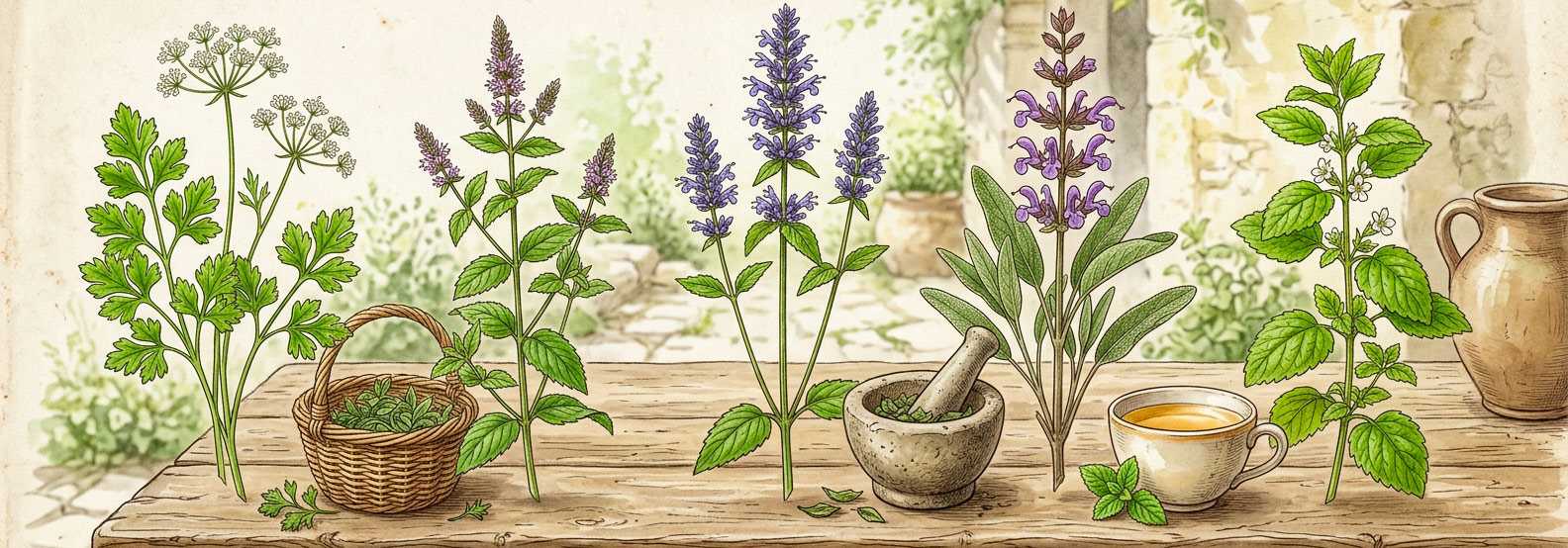
Long before becoming simple kitchen herbs, these plants accompanied meals, infusions, and everyday ailments. Digestion, sleep, a sore throat, or frayed nerves: what did people once credit them with, and what can we reasonably take from that today?
In old gardens, aromatic plants weren't grown only to flavor food. They were also harvested to prepare infusions, aromatic waters, gargles, poultices, and various home remedies. Some of these uses have stood the test of time. Others rest more on the beliefs and medical theories of their era than on any effect that's actually been demonstrated.
Good to know
The word "virtues" here is used in its traditional sense. When a plant has a "traditional use" recognized by European health authorities, that means its use is old and considered plausible — not that a clinical trial has proven it. This nuance applies to all five plants below, so we won't repeat it in every paragraph.
Parsley, the herb meant to wake up the body
Far from being a simple garnish on the edge of the plate, parsley used to be taken seriously.
What it was once credited with
In folk traditions, its leaves, roots, and especially its seeds were used to:
- stimulate digestion
- ease that heavy, sluggish feeling
- increase urine output
- freshen the breath
- help with especially rich meals
Different traditions also credited it with effects on the kidneys, liver, and menstrual cycle. Its seeds and essential oil are far more concentrated than the leaves used in cooking — the scientific literature mostly confirms the historical existence of these digestive and diuretic uses, without robust clinical data to back them up.
What's worth remembering today
Parsley remains, above all, an excellent kitchen herb. Added raw and generously to a salad, tabbouleh, or sauce, it adds flavor and helps vary the vegetables you eat. Its strong scent also explains its old use for masking certain food odors on the breath — but it doesn't "detoxify" anything, and a few sprigs won't treat a urinary or digestive condition.
Mint, the after-dinner ally
A cool scent, and centuries of reputation for "settling the stomach."
What it was once credited with
After a heavy meal, it was served as an infusion to:
- ease that heavy feeling
- reduce gas
- calm digestive spasms
- freshen the mouth
Peppermint, Mentha × piperita, is the best documented: the European Medicines Agency recognizes the traditional use of its leaves for mild digestive complaints, including indigestion and flatulence.
What's worth remembering today
A light infusion after a meal, or a few fresh leaves in a salad, some peas, or yogurt: mint fits in easily. It's not for everyone, though — it can worsen acid reflux, and caution is advised if you have gallstones. Leaf, extract, and essential oil aren't interchangeable: the oil is far more concentrated.
Anise hyssop, the fragrant newcomer
A scent of anise and licorice, and a history that crosses the Atlantic.
"Agastache" covers several species. In European gardens, the most common is anise hyssop, Agastache foeniculum, native to North America — its leaves and flowers flavor infusions, salads, pastries, and fruit. Other species, such as Agastache mexicana, belong to different medicinal traditions entirely, and it's best not to assume they share the same uses.
What tradition credited it with
Anise hyssop was used in North America for drinks meant to accompany colds, coughs, throat discomfort, and digestive troubles — uses reported mainly by ethnobotanical sources, which aren't enough on their own to demonstrate medical effectiveness.
What's worth remembering today
Anise hyssop is above all valuable as an aromatic, edible, bee-friendly plant: a few leaves are enough to flavor a tisane, a fruit salad, a compote, or a syrup. Unlike mint, sage, and lemon balm, it doesn't have a European medicinal monograph precisely defining its uses.

Sage, the herb once thought to cure everything
Its Latin name is tied to the idea of saving or healing — its reputation was once considerable.
What it was once credited with
In herbals and household practice, common sage, Salvia officinalis, was used to ease difficult digestion, reduce bloating, calm irritation of the mouth and throat, limit excessive sweating, and support memory with age. European evaluations recognize several of these traditional uses, including mild digestive complaints and minor skin inflammation.
What's worth remembering today
Sage remains a valuable herb for flavoring beans, squash, meats, or butter, and a light infusion has kept its traditional after-meal use — even as a gargle for a sore throat. But it's a powerful plant: it contains thujone, and too much of it can cause unwanted neurological effects.
Watch out
Common sage essential oil is particularly concentrated. The European Medicines Agency concluded that its benefits didn't sufficiently outweigh its risks to recommend therapeutic use. It should never be added casually to an infusion, a drink, or a dish.
Lemon balm, the herb for frazzled days
A lemony scent, and an old reputation for calming whatever's stirred up.
What it was once credited with
Lemon balm, Melissa officinalis, was brewed as an infusion to calm agitation, help with falling asleep, ease digestion made harder by nervousness, and soothe palpitations blamed on emotion. The European Medicines Agency recognizes its traditional use for mild stress, sleep, and moderate digestive complaints like bloating and flatulence — while noting that available studies don't establish firm clinical certainty.
What's worth remembering today
Probably the easiest of the five to work into daily life: its young, fresh leaves flavor infusions, strawberries, compotes, or flavored water. Its scent is finer fresh than dried. A lemon balm infusion pairs well with a moment of rest, but it isn't a treatment for significant anxiety, persistent insomnia, or heart conditions.
Mint or lemon balm: how to tell them apart
Both plants are welcome after a meal, but their personalities differ. Mint is fresher, livelier, traditionally tied to digestion. Lemon balm has a softer, lemony scent and an old reputation as a calming plant. To tell them apart, gently crush a leaf: lemon balm smells unmistakably of lemon, while mint stays cooler and more menthol.
Five plants, five virtues: the recap
| Plant | Traditional virtues |
|---|---|
| Parsley | Digestion and urinary elimination |
| Mint | Heavy digestion and bloating |
| Anise hyssop | Digestion, throat and comforting drinks |
| Sage | Digestion, mouth, throat and sweating |
| Lemon balm | Relaxation, sleep and nervous digestion |
How to enjoy them simply
The safest way to enjoy these herbs remains simply eating them:
- a handful of parsley in salads and sauces
- a few mint leaves over vegetables or fruit
- an anise hyssop leaf to flavor a compote
- one or two sage leaves in a slow-cooked dish
- fresh lemon balm in a pitcher of water
For a homemade infusion, choose correctly identified, untreated plants harvested somewhere clean — and avoid mixing several herbs in one brew, so you can better appreciate the flavor and spot any poor tolerance.
Natural doesn't mean risk-free
A plant eaten occasionally as a kitchen herb doesn't act the same way as an extract, a tincture, or an essential oil. Caution matters especially during pregnancy and breastfeeding, for young children, with liver, kidney, or gallbladder conditions, alongside medication, before surgery, or when a symptom persists or worsens. Essential oils should never be swallowed simply because the plant itself is edible.
"These old uses are an interesting heritage — not a prescription."
Parsley, mint, anise hyssop, sage, and lemon balm once occupied a middle ground between the vegetable garden, the kitchen, and the medicine cabinet. Today, their finest quality might be the simplest one: they flavor meals, add variety to what we eat, and turn an ordinary cup of hot water into a real garden pleasure.