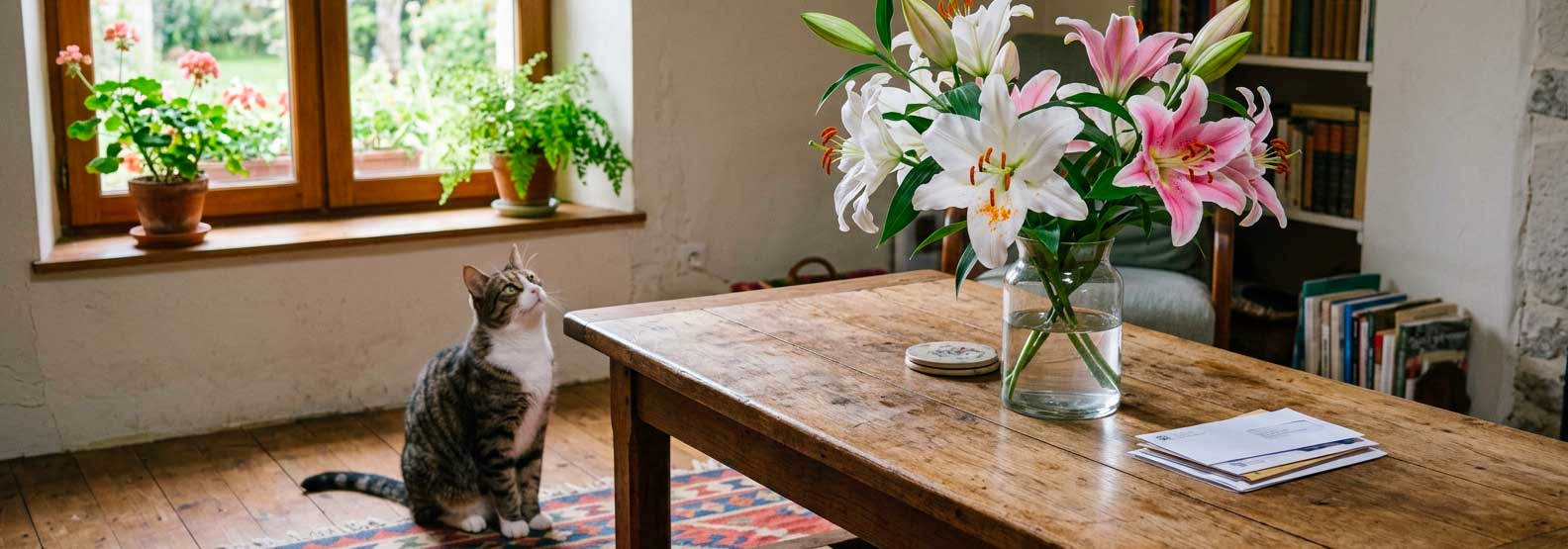
A lovely bunch of lilies on the living room table: what could be more innocent? Nothing, unless a cat shares your home. In that case, you have just placed one of the most dangerous plants there is for them right in the middle of the room.
In cats, lilies can cause sudden kidney damage. And unlike many toxic plants, it doesn't take a feast: a few grains of pollen licked off the fur, or a sip of water from the vase, are already enough to put our feline friends in serious danger.
Every part of the lily is dangerous. Every single part.
For true lilies of the genus Lilium (Asiatic lilies, Oriental lilies, Easter lilies, Stargazers, tiger lilies…) and for daylilies (Hemerocallis), every part of the plant is highly toxic:
- the flowers;
- the leaves;
- the stems;
- the pollen;
- and even the vase water, which looks perfectly harmless.
So your cat doesn't need to decide to "eat a plant". All it takes is brushing past the bouquet, walking off with a little pollen on its coat, then doing what it does best after sleeping: grooming. And just like that, it's poisoned without asking for anything.
Why are lilies so dangerous for cats?
A small scientific mystery: the substance responsible still hasn't been precisely identified. What we do know is that it destroys kidney cells in cats and can lead to acute kidney failure.
The first signs can appear quickly: vomiting, drooling, loss of appetite, a listless cat who no longer feels like doing anything, not even ignoring you. Kidney damage then develops over the following hours and, without treatment, can become fatal within a few days.
A tiny amount can be enough
That's what makes this flower so treacherous. According to the FDA (the US Food and Drug Administration, which also oversees veterinary medicines), a bit of leaf or petal, a few grains of pollen or a little vase water can be enough to cause serious poisoning.
And no, putting the bouquet "high enough that the cat can't reach it" doesn't solve anything. Pollen falls, and petals and leaves eventually drop too. As for the cat, it has a special talent for reaching places you thought were out of bounds. It's practically its job.
"Out of reach" isn't part of a cat's vocabulary.
Are all "lilies" this dangerous?
No, and this is where common names cause chaos. The real culprits for a cat's kidneys are true lilies (Lilium) and daylilies (Hemerocallis). Other plants with "lily" in their name don't cause the same kidney poisoning.
- Peace lily (Spathiphyllum) contains calcium oxalate crystals. They strongly irritate the mouth and can cause drooling or vomiting, but they don't lead to the kidney failure caused by true lilies.
- Alstroemeria, also called Peruvian lily or lily of the Incas, can cause digestive upset, but it doesn't have the same kidney toxicity.
Watch out
Different doesn't mean harmless: these plants are still toxic, just in a different way.

What to do if your cat has touched or eaten a lily
Don't wait for symptoms. No "let's see how it goes tomorrow".
Has your cat chewed a lily, drunk the vase water, or got pollen on its nose or coat? Call your vet or an emergency veterinary service immediately, and make sure to say it's a lily.
The earlier treatment starts, the better the chances of avoiding kidney damage. Once kidney failure has set in, the outlook becomes much bleaker.
With a cat at home, the simplest rule: no lilies
Here, moving the vase isn't enough. Pollen travels, and a wilting flower always ends up dropping a petal or a leaf somewhere. The ASPCA (the American Society for the Prevention of Cruelty to Animals, which also runs an animal poison control center) therefore advises cat owners not to bring Lilium or Hemerocallis into the house at all.
Good to know
If someone gives you lilies, they'll look gorgeous… in the home of someone without a cat. Or in the garden, well away from your cat's usual routes.