Imagine being able to create a new vegetable garden without turning the soil, without a rotovator, and without fully weeding the ground. That's exactly the principle of the so-called "no-dig" method, popularised in the 1970s by Australian gardener Esther Deans. The idea is simple: instead of working the soil deeply, you build a new bed directly on top of the existing ground.
This technique can be used on a lawn, a tired old vegetable patch, stony ground, or even a former paved area. Here are the six essential steps.
Smother the grass
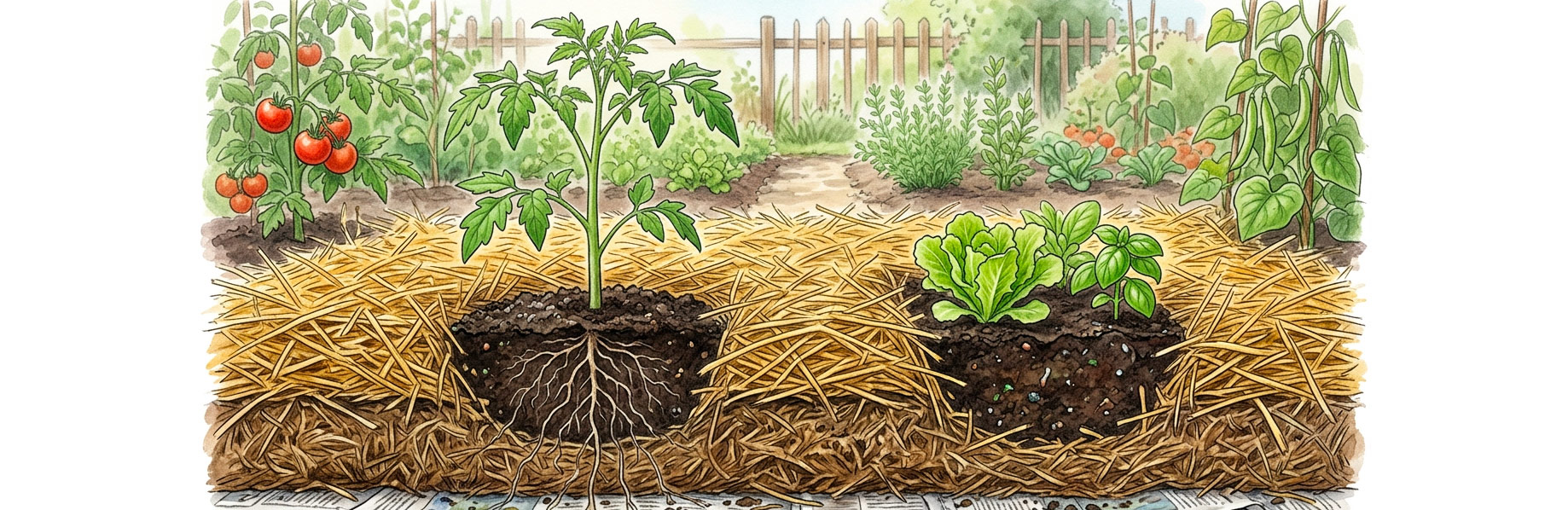
Cover the ground with several layers of well-dampened newspaper — around 10 to 15 sheets thick, overlapping generously. This layer blocks light. The grass underneath gradually dies and decomposes naturally. A few months later, the paper will also have disappeared.
Add a rich layer
On top of the newspaper, place a layer of nitrogen-rich hay — in the original method, lucerne or an equivalent — about 10 to 20 cm deep. Its role is twofold: to feed the soil organisms and to start decomposition. A little manure or organic fertiliser is then added on top.
Create aeration
A layer of straw about 20 cm deep is placed on top. Straw feeds less than hay, but it provides a light structure. It creates air pockets and prevents the whole thing from compacting — much like twigs do in a compost heap.
Never forget the water
Each layer must be thoroughly watered before moving on to the next. Moisture allows bacteria, fungi and earthworms to start working immediately. Without water, decomposition slows considerably.
Create planting pockets
Rather than filling the entire bed with soil, small hollows are scooped into the top layer — called "bird nests" in the original method — and filled with mature compost. Seedlings or young plants are set into these pockets. The roots immediately find a rich medium, then gradually explore the layers below.
Mulch
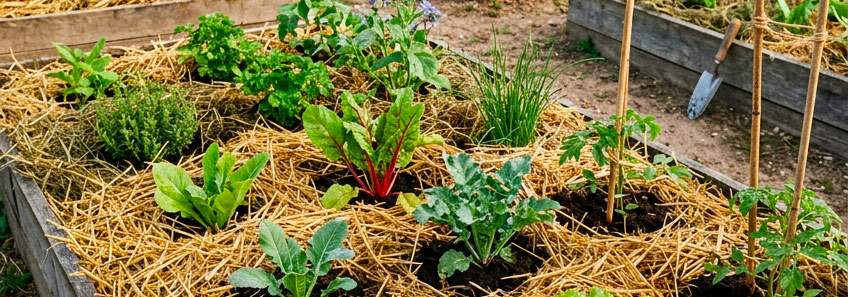
A final light layer of mulch is added to reduce evaporation. The bed is then ready to grow in.
Why this method works
The newspaper smothers the existing vegetation. The hay feeds soil life. The straw brings air. The compost provides a fertile medium for young plants. While the vegetables grow, all these layers slowly decompose and turn into humus. In other words, the garden builds itself over the coming months.
Key takeaway
This method requires more organic material upfront than simple digging. In return, it avoids turning the soil and allows a productive bed to be created quickly, even on a lawn or difficult ground. The principle isn't to work harder — it's to let decomposition do part of the work for you.