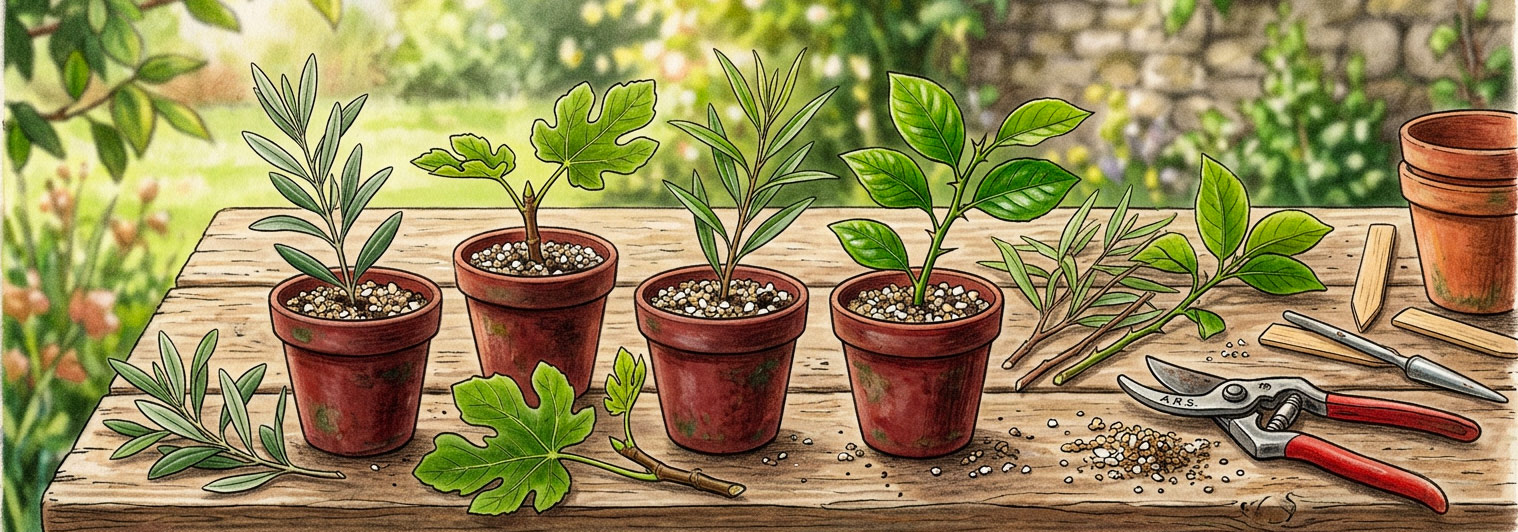
This year, I gave olive tree cuttings a try. A few pieces of branch, a pot, some potting soil, a bit of vermiculite (I'm still not entirely sure what that is, but Amazon sells it). I followed every tip from Instagram, YouTube, Google, mixed it all together, and against all odds, a few weeks later, new shoots appeared.
Naturally, since it worked (not too badly), the next question is obvious: can I do the same with the other trees in the garden? (Or the neighbor's, but shh.) When? How? So here's a little tour of what I'm planning to try next.
Not every tree is equally willing to be propagated
First observation: no, you can't just cut any old branch, stick it in a pot, and wait for it to politely turn into a tree. That would be too easy.
Some trees are downright cooperative. Willow, for instance, practically seems to want to grow roots the moment you look at it a bit too closely. Proof: last year I made willow water (for cuttings, more on that below), just a few willow branches in water, and poof, it grew leaves, then roots.
Other trees need a bit more finesse: choosing the right branch, at the right time, and not roasting it under a mini greenhouse in full sun. And then there are the ones that clearly prefer to be left alone and grafted instead. (That's the final boss.)
The olive tree: my starting guinea pig
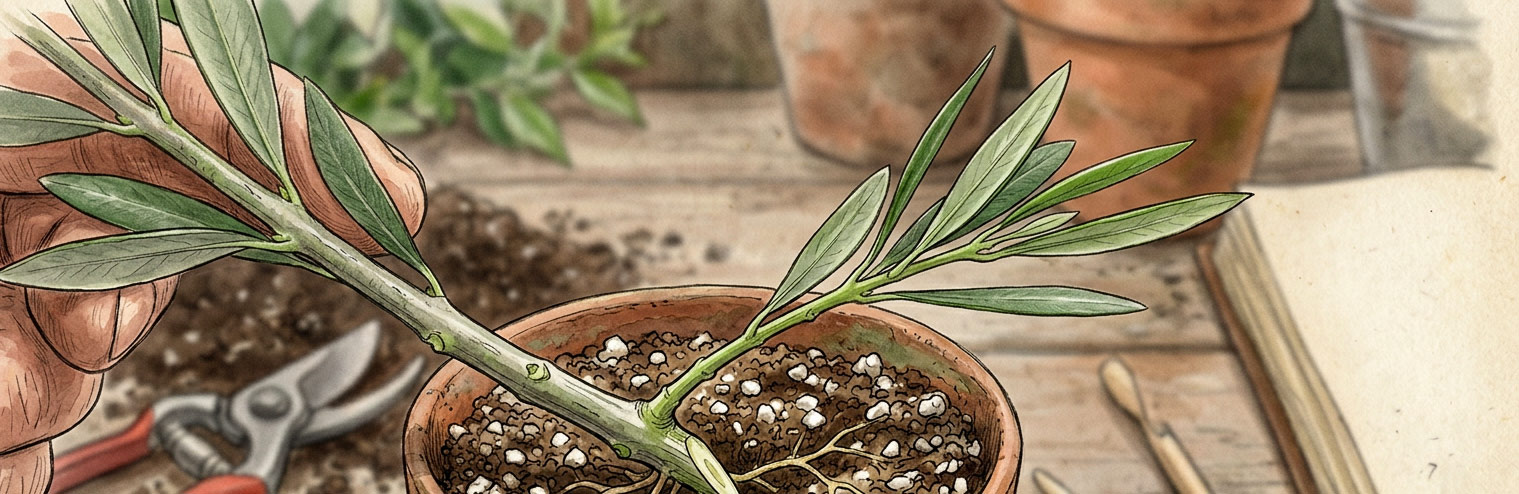
Since it's the one that started it all, might as well begin there. Olive trees root fairly well in summer, from this year's branches that are starting to harden without being fully turned to wood yet. This is what's called a semi-hardwood cutting.
In plain terms: skip the soft little tip of the branch, but don't cut off an old, fully woody one either. Aside from the fact that my husband (proud owner of said olive tree) might put a hit out on me, I quickly realized there wasn't much point in that anyway.
Take a piece about ten centimetres long, remove the lower leaves, keep a few at the top, then plant it in something light and well-draining. In my case: potting soil and vermiculite. Then, light, humidity, patience.
The hardest part is not digging the thing up every three days to check whether it's finally decided to grow roots. And if the leaves wilt, it's not necessarily dead: persistence, persistence!
The fig tree: the confidence booster
The fig tree is noticeably friendlier. This one roots quite easily, especially from well-formed wood. A branch about twenty centimetres long, a pot or straight into the ground, and you just let it be. You can try it in autumn or winter, using well-lignified wood.
And since fig trees also readily produce suckers and layer themselves without much persuading, it's clearly a tree that has nothing against the idea of reproducing. If my olive cuttings keep holding up, the fig tree will probably be next on my list. (In the end, yes, I already have three fig trees.)
Willow: this one is almost cheating
Willow is probably the champion of the category. A branch planted in damp soil can produce roots with almost insolent ease. It's mostly propagated from well-formed wood, during the dormant period, so autumn to winter.
Honestly, if you want to build up your confidence before tackling something trickier, start with this one. Just dropping a branch fully submerged in water, in the sun, gave me a good result. It saves you from concluding after three failed attempts that you're simply cursed with cuttings.
Mulberry: very tempting too
Mulberry can also be propagated from hardwood. Same principle: wait until the branches are well lignified, take a healthy branch, cut it into pieces, then plant. The idea is to bury a good portion of it to encourage root formation. It's not necessarily the fastest method, but it's well worth trying.
It's essentially a bramble relative, and bramble water is also used to help with cuttings, just like its cousin willow. I might be onto something there.
Poplar: not glamorous, but it works
Poplar also propagates well from hardwood cuttings. Take branches in autumn or winter, plant them fairly deep, and wait. It's the kind of tree you don't necessarily think of multiplying at home, because, well, a little poplar grove is nice, but... Anyway, technically, it works. Though you do first need to actually want a poplar (or several).
What about citrus trees?
Now this gets interesting. Lemon, orange, mandarin: these can be propagated too. I'm very curious about this one, I've even tried sprouting lemon pips. That works reasonably well. But I'll have lemons by the time I'm in a nursing home.
Work with these in spring or summer, on branches that are still young but starting to firm up. Remove the lower leaves, keep a few at the top, plant in a light substrate, and maintain good humidity. But no full sun behind glass: otherwise you're not making a cutting, you're making a foil-wrapped parcel. Full disclosure, that's exactly what happened to my lovely willow cuttings, but shh.
What about apple, pear and cherry trees?
This is where the enthusiasm dips a little. Yes, some cuttings can occasionally take. But it's generally not the best way to reproduce these trees. For them, grafting is the way to go.
Why grafting instead of cuttings?
Because the rootstock plays a huge role: it influences vigour, the tree's final size, and sometimes how well it adapts to the soil. So if you have a perfect apple tree at the bottom of the garden and want to reproduce it faithfully, it's better to learn grafting than to spend six months watching a branch pretend to think about it.
How I'll approach the next batch
I'm sticking with the simplest method possible.
A healthy branch
No disease, no dodgy-looking leaves, no half-withered branch picked up "just to see." Might as well start with the best odds possible.
A clean cut
I cut just below a node, meaning the spot where a leaf or bud emerges. That's often a favourable zone for root formation.
Few leaves
I remove the lower ones and keep only a few at the top. If they're quite large, you can even trim them a little to limit evaporation, because a cutting without roots loses water much faster than it can take it up.
A light substrate
No need for ultra-rich potting soil. What matters most is something that holds a bit of moisture without turning into a swamp: potting soil, sand, perlite, vermiculite (now that we know it exists). Basically, all the things you end up buying after watching three propagation videos.
Moisture, but not a swimming pool
The substrate should stay moist, not soaked. And if you put a cloche or a clear bag over it, remember to air it out. Otherwise, you'll quickly grow more mould than trees.
What about rooting hormone?
I've seen it mentioned everywhere in the tutorials. Some swear it's essential, others never use it at all. In reality, it can help with certain species, especially the ones that root with difficulty, but it's not a magic potion. If the branch is poor, the timing is off and the substrate is waterlogged, no amount of powder will save it.
So yes, why not. But I'm not about to turn my kitchen into a lab either.
How do you know if it worked?
This is where it gets tricky, because at first, you see nothing. The branch is there. It's green. It's not dying. But that doesn't necessarily mean it's grown roots.
The best sign is the appearance of new shoots. That's exactly what happened with my olive cuttings, and at that point, you naturally start thinking something must be going on underground. You can also give the cutting a very gentle tug to see if it resists. Very gentle. Not like you're trying to pull up a carrot.
My little propagation schedule
To avoid trying random things at random times, here's what I'm sticking to:
| Season | Trees |
|---|---|
| Spring / early summer | A few attempts on soft young growth |
| Summer | Olive, citrus and other semi-hardwood cuttings |
| Autumn / winter | Fig, willow, mulberry, poplar |
| Apple, pear, cherry | Saving my energy to learn grafting (but I will, and I'll be so proud!) |
"The best sign is the appearance of new shoots. And at that point, you naturally start thinking something must be going on underground."
What about willow water? And bramble water?
Since we're on the subject of rooting hormones, it's impossible not to eventually run into willow water. The principle is simple: soak young willow branches, cut into pieces, in water, then use that water to soak or water your cuttings.
Why willow? Because it naturally contains various compounds linked to plant growth and defence, notably salicylic acid and substances from the auxin family. On paper, it holds together. In real life, it's a bit less magical than what you sometimes read online: some experiments show good results, others show little to no difference compared to plain water. But given how easily willow itself roots, I admit it's tempting to try.
With willow water, I managed to root lavender (which isn't the hardest thing to propagate anyway). Honeysuckle, bougainvillea and bottlebrush, on the other hand, didn't take. Though I can't rule out that it was me who got something wrong, not the method.
You'll find a similar trick with young bramble stems. Brambles also root with remarkable ease the moment a stem touches the ground, which probably explains how they earned this reputation. But here, the evidence is much thinner. So for now, I'm filing this under: "it costs nothing to try, we'll sacrifice a few more branches."
And since I have willow (well, had, I need to track some down again), brambles, and apparently far too much enthusiasm for propagating things, I have a feeling a little homemade comparison is going to happen eventually.