When a chilli plant finally decides to produce, after a good deal of patience, it doesn't always do things by halves.
A few fruits, fine. But you quickly start wondering what possessed you to plant several chilli plants.
And when the end of the season arrives, one fairly simple question remains: what do you do with all of it?
Good news: chillies keep rather well, and there are several methods depending on what you want to do with them afterwards.
1. Dry them
This is probably the oldest and simplest method.
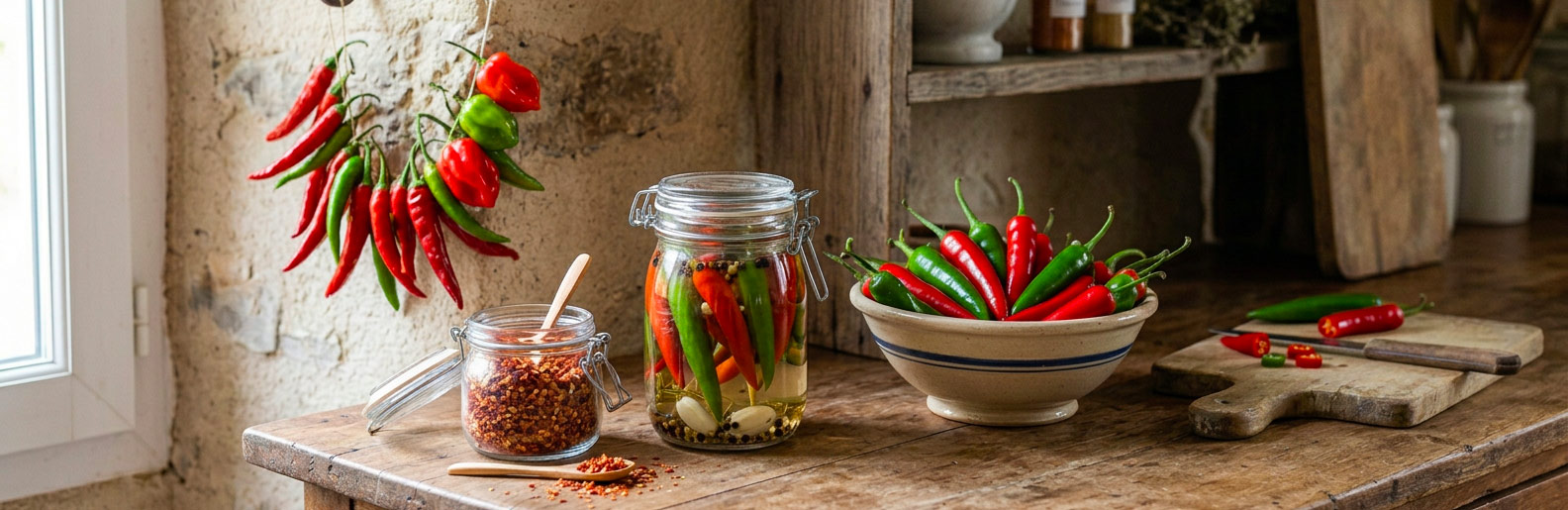
Small thin-fleshed chillies can be dried whole, hung somewhere dry and well ventilated. Chillies are among the vegetables commonly air-dried.
For fleshier varieties, a dehydrator is more reliable. And that isn't just about convenience: a thick chilli air-dried in a damp room will go mouldy from the inside before it has finished drying.
Once thoroughly dry, they can be stored whole in a sealed jar.
And above all, don't grind them all to powder straight away. A whole chilli usually holds on to its aroma better.
2. Turn them into flakes or powder
Once dry, chillies can be crumbled into flakes or ground more finely.
This is probably one of the most practical ways to store a big harvest: a great many chillies end up in one small jar.
Careful when grinding
Capsaicin is not especially pleasant in your eyes or your airways. For the hottest varieties, consider wearing gloves. And open a window: the powder rising from the grinder behaves rather like tear gas, and that isn't an exaggeration.
3. Freeze them
Simpler still: the freezer.
Just wash the chillies, remove the stalk, pack them and freeze. No blanching is needed.
You can freeze them whole or already sliced.
After thawing they'll have lost some of their crunch. Then again, one rarely bites straight into a chilli. Unless a bet has been lost.
4. Put them in vinegar
Here we step straight into the world I like best: old cookbooks.
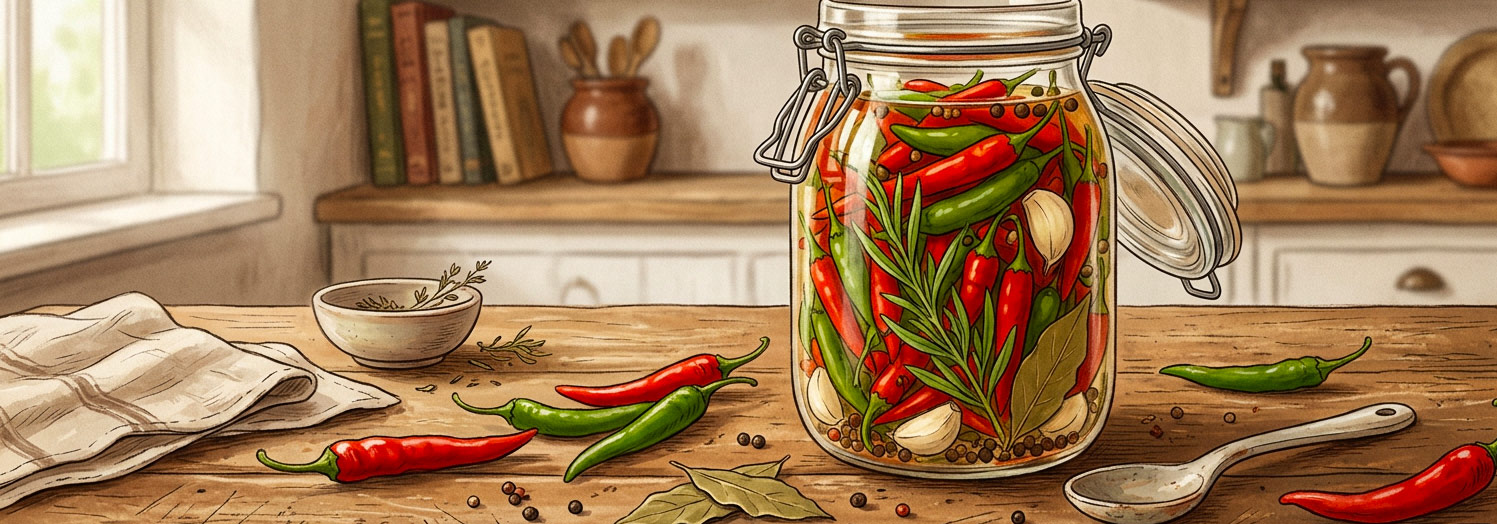
I came across an old recipe for chillies, or sweet peppers, in vinegar that works in two stages.
The fruits are first left in an initial vinegar for a fortnight. That vinegar, diluted by the water the fruits release, is then thrown out and replaced with fresh vinegar flavoured with garlic and tarragon.
The idea is a clever one: the first bath serves to draw the water out of the vegetable, and the second becomes the actual preserving liquid.
And that detour isn't just old-cookbook elegance. It's precisely why the method works: vinegar diluted by the water from the fruits loses acidity, and with it its preserving power. The second bath restores what's needed.
Chillies are a low-acid vegetable. So you need a vinegar of at least 5% acidity.
5. Make a hot sauce
Another obvious route: sauce.
Jalapeños, habaneros, cayennes and other varieties can all become a sauce of varying heat, with vinegar, aromatics and, in some recipes, fermentation.
For a sauce you want to keep for a long time outside the fridge, follow a proper tested recipe rather than improvising the acidity. This isn't excessive caution: an insufficiently acidic sauce, in a sealed bottle at room temperature, is exactly the sort of environment where botulism can develop.
For a fresh sauce kept in the fridge and eaten within a few weeks, you have far more freedom.
And in the past? Chillies weren't only kept whole
This is where my old books get interesting.
I found a chilli vinegar from Chile in one of them: the chilli steeps in vinegar for a month, then the vinegar is strained and bottled.
"In other words, you're no longer really preserving the fruit. You're preserving its heat."
I also came across a recipe for Karrik des Indes, a spice blend containing coriander, turmeric, pepper, chilli, saffron and mace. The chilli is dried, then pounded with the other spices.
It's a different logic of preservation altogether: turning a small quantity of chilli into a dry condiment capable of flavouring a great many dishes.
The Karrik des Indes recipe
Take 60 g coriander, 15 g turmeric, 10 g pepper, 10 g chilli, 10 g saffron and 10 g mace.
Dry the chilli, then pound it with the pepper, coriander and mace. Add the powdered turmeric and the saffron, then pass everything through a Venice sieve, a very fine silk sieve that today would be replaced by a fine-mesh strainer or a flour sifter.
Store in tightly corked bottles, away from light, heat and damp. It keeps for a very long time. Everything in it is dry.
A sensible adaptation
The 10 grams of saffron in the original recipe would cost a small fortune today. A knife-tip is plenty to flavour the blend.
Worth noting too: books of the period sometimes used "saffron" to mean safflower, nicknamed bastard saffron, which served as a cheap substitute.
The result is a condiment worth rediscovering, and it smells wonderfully of the East.
Which method to choose?
- To keep the fresh flavour as far as possible: freezing.
- To take up almost no space and stay within reach: drying, then powder.
- If you like condiments: vinegar or pickles.
- If you have an enormous harvest: do a bit of everything.
Because after three weeks of eating fresh chillies, the whole family, and the neighbours, will be demanding a plan B.
And sometimes even a plan C.